Shipping Container Types & Sizes
Side-by-side specifications for every standard shipping container - 20ft and 40ft dry boxes, high cubes, reefers, open tops, flat racks and ISO tanks - with internal and external dimensions, cubic capacity and weight limits.
Dry / General Purpose
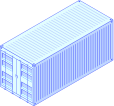
20ft Standard
1 TEUThe backbone of ocean freight - one TEU of enclosed dry cargo space.
- Capacity
- 33.2 m³
- Max Payload
- 28.3 t
- Length
- 20ft
40ft Standard
2 TEUTwice the floor space at a similar payload - the volume workhorse.
- Capacity
- 67.7 m³
- Max Payload
- 26.7 t
- Length
- 40ft
High Cube
40ft High Cube
2 TEUA foot more height, about 13% more cubic capacity.
- Capacity
- 76.4 m³
- Max Payload
- 28.6 t
- Length
- 40ft
45ft High Cube
2.25 TEUThe longest box in general service, with the most cubic capacity.
- Capacity
- 86.1 m³
- Max Payload
- 25.6 t
- Length
- 45ft
Refrigerated
20ft Reefer
1 TEUCold-chain transport with precise temperature control in a 20ft footprint.
- Capacity
- 28.3 m³
- Max Payload
- 27.5 t
- Length
- 20ft
40ft Reefer
2 TEUHigh-cube cold chain built for long-haul perishables.
- Capacity
- 67.3 m³
- Max Payload
- 27.7 t
- Length
- 40ft
Open Top
20ft Open Top
1 TEUTop-loading box for tall cargo lifted in by crane.
- Capacity
- 32 m³
- Max Payload
- 28.1 t
- Length
- 20ft
40ft Open Top
2 TEUFull-length top access for long and tall loads.
- Capacity
- 66.7 m³
- Max Payload
- 26.7 t
- Length
- 40ft
Flat Rack
20ft Flat Rack
1 TEUPlatform with folding ends for heavy, over-width loads.
- Capacity
- -
- Max Payload
- 30.1 t
- Length
- 20ft
40ft Flat Rack
2 TEUHeavy-lift deck for project and out-of-gauge cargo.
- Capacity
- -
- Max Payload
- 40.0 t
- Length
- 40ft
Tank
Dimensions and weights here follow the commonly published ISO standards; manufacturers, series and lessors vary slightly. Treat the figures as a planning and load-calculation baseline and confirm the exact specification with your carrier before booking. Once the cargo is at sea, any container can be tracked by number for live status, ETA and port-call history.
Container types FAQ
The 20ft and 40ft boxes dominate. Both are 8ft wide and, in standard height, 8ft 6in tall; high-cube versions add roughly a foot. The longest box in general service is the 45ft high cube. Exact internal and external dimensions for each type are listed above.
TEU stands for Twenty-foot Equivalent Unit, the yardstick for container capacity based on the volume of a single 20ft box. A 20ft container is therefore 1 TEU and a 40ft container 2 TEU. Ports and carriers report throughput and ship capacity in TEU.
A high cube stands about one foot (0.3 m) taller - 9ft 6in of external height against 8ft 6in - which adds roughly 13% of internal volume. Length, width and door width are unchanged, so high cubes pay off on light, bulky cargo.
It depends on the type: most 20ft and 40ft dry boxes take around 26,000–28,500 kg, capped by a maximum gross weight of roughly 30,480 kg. Flat racks are reinforced for out-of-gauge loads of 30,000–40,000 kg. The exact tare, payload and gross weight for each type is given on its own page.
Dry containers for general palletised freight, high cubes for bulky or tall loads, reefers for temperature-controlled goods, open tops for crane-loaded or over-height items, flat racks for heavy or over-width project cargo, and ISO tanks for bulk liquids and gases. Every container page names the cargo it fits best.